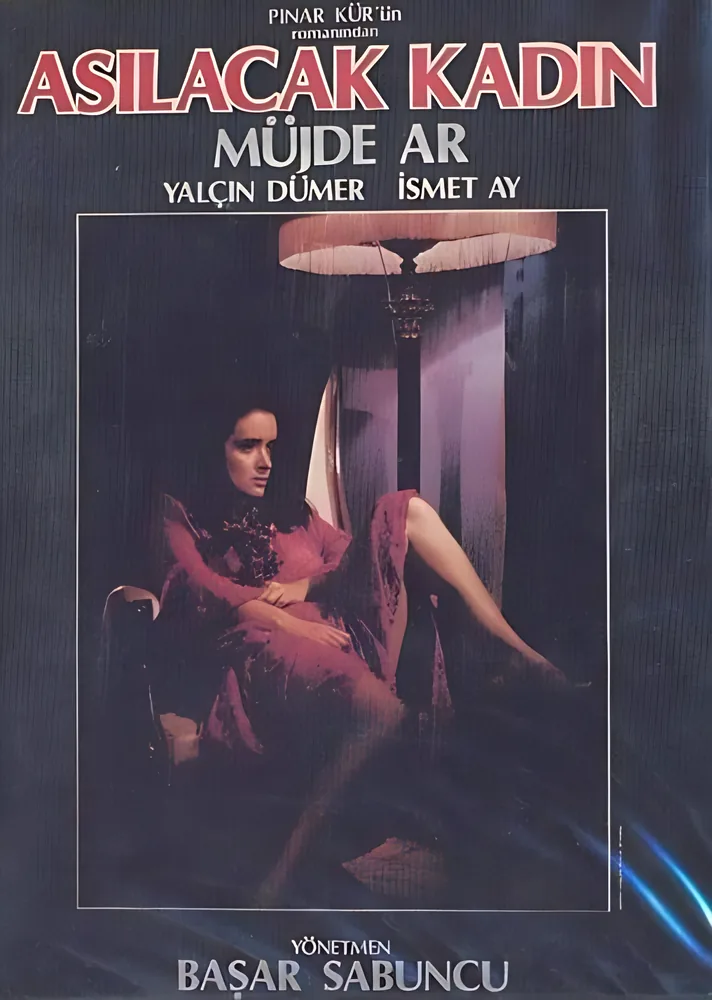
The Woman Whom Must Be Hanged (Asılacak Kadın)

The Woman Whom Must Be Hanged (Asılacak Kadın)

Movie · 1986 · 8 people

Asılacak Kadın (literally "the woman to be hanged") is a 1986 Turkish crime drama adapted from Pınar Kür's novel of the same name. Başar Sabuncu directed it from his own screenplay, with Ferit Turgut producing for Uzman Film. Drawn from a contested book, the film won the right to be shown through a ruling of the Council of State.

At its center is Melek (Müjde Ar), a very young woman with little schooling who marries Hüsrev (İsmet Ay), the elderly man whose house she serves as a maid. As the marriage goes on, Hüsrev's long-suppressed obsessions come to the surface and turn into abuse, as he pushes his wife toward other men. Yalçın Dümer plays Yalçın, who has loved Melek without hope for years, and Güler Ökten plays Emsal.

Kür's novel was first published in 1979 by Bilgi Yayınevi and grew out of a real case in Edirne that the writer Halide Nusret Zorlutuna passed on to her. In the book, the story of Melek, sentenced to death, unfolds in a courtroom and is told in turn by three voices: the judge Faik İrfan Elverir, Melek Ebruzade and the young Yalçın Özveren. Kür uses it to criticize the place society gives women and how people judge a woman from outside without knowing her reasons.

DirectorBaşar Sabuncu
ScreenwriterBaşar Sabuncu
Production companyUzman Film

Reactions

You can pick up to 3 reactions.

Cast

Through different eyes

AI-assisted editorial takes written from different viewer perspectives. They are not reader reviews; those are below.

Yeşilçam Nostalgic A viewer raised on the classics, looking for warm storytelling and strong acting.

To an eye raised on Yeşilçam's warm stories, Asılacak Kadın is not an easy film. It starts from a real case in Edirne, and the abuse at its heart is not the kind the old melodramas could soften with tears. Still, at its core lies a morality the classics knew well: stand with the wronged, and try to understand before you judge. Resting on Pınar Kür's novel also gives it literary weight. It is not for anyone hoping for a comforting evening, but those who value films willing to take on a hard subject will find much to think about.

History & Society Lens Asks about the period, the social background and what the work reflects.

Asılacak Kadın is best read within its own time. That a film adapted from a contested novel could reach screens only through a ruling of the Council of State says on its own how sensitive the subject was in its day. The story's social knot lies in class and age: a very young maid with little schooling marrying the elderly owner of the house she serves means an unequal relationship from the very start. Kür's real target is less one man than society's habit of judging a woman from outside without knowing her reasons. That, in my view, is why the story can still make viewers question their own assumptions.

Cinephile Looks at script, editing and directing choices; keeps a distance from formula films.

Başar Sabuncu also wrote the screenplay, so the adaptation comes from a single hand, which is both an advantage and a risk. Pınar Kür's novel draws its strength less from events than from form: the story of a woman sentenced to death unfolds in a courtroom, told in turn by the judge, Melek and Yalçın. That polyphony is hard to bring to the screen, and an adaptation of such a book always risks shrinking its question of judgment into an ordinary relationship drama. The second test is tone: a film about abuse reproduces the very gaze the novel criticizes the moment its camera turns Melek into an object. Weighing the film by those two measures is more rewarding than simply applauding it for a brave choice of subject.

Reviews (0)

Log in Log in to write a review.

Comments