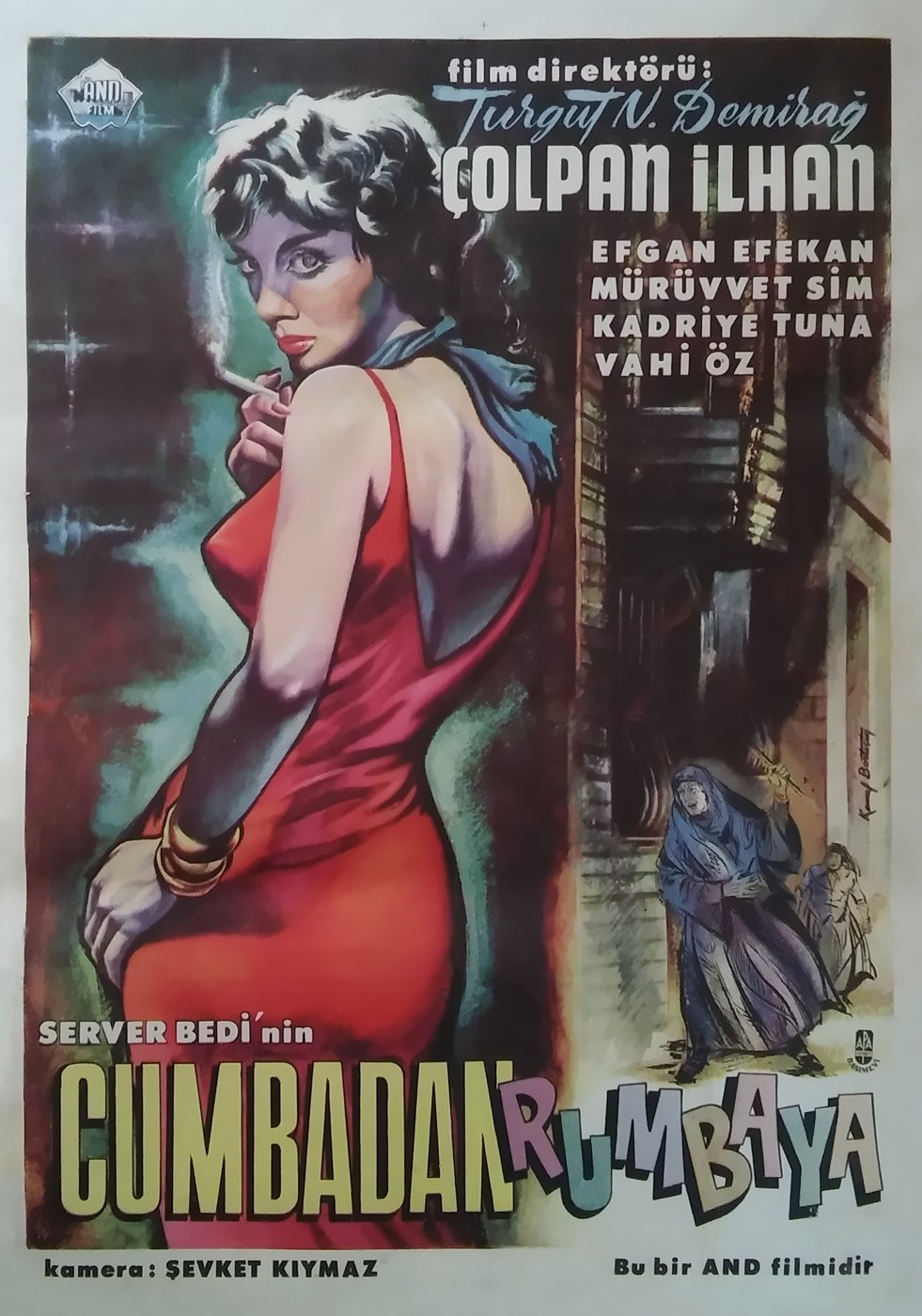
From Cumba to Rumba (Cumbadan Rumbaya)

From Cumba to Rumba (Cumbadan Rumbaya) (translated)

Movie · 1960 · 6 people

Cumbadan Rumbaya is a 1960 Turkish romantic comedy adapted from the 1936 novel of the same name that Peyami Safa published under the pen name Server Bedi. Turgut Demirağ directed, wrote and produced it for And Film and Lale Film, with Çolpan İlhan and Vahi Öz in the leading roles.

Cemile (Çolpan İlhan), the headstrong but honest wild girl of Karagümrük, has lost her heart to Selim (Efgan Efekan), the university student who rents a room in her family's house, and will hear of marrying no one else. She also longs to trade the run-down family house she shares with her mother (Kadriye Tuna) and widowed sister Şahinde (Mürüvvet Sim) for an apartment in Nişantaşı and a rich husband. Tahsin (Vahi Öz), a businessman from Kayseri she meets in a quarrel on a city bus, offers to make that dream real and rents them a flat in Taksim. Over his visits he comes to see Cemile in place of the daughter he lost, yet still uses her in his dealings. Sadri Alışık, who voices Selim, also appears on screen as an announcer.

In 2005 the novel became a TRT 1 series directed by Yücel Çakmaklı from a script by Halit Refiğ, with music by Melih Kibar, starring Arzu Yanardağ as Cemile and Halit Akçatepe as Tahsin.

DirectorTurgut Demirağ
ScreenwriterTurgut Demirağ
Production companyAnd Film, Lale Film

Reactions

You can pick up to 3 reactions.

Cast

Adile Naşit Adile Naşit Film actor · died at 57 Madam Çolpan İlhan Çolpan İlhan Actor · died at 77 Cemile Vahi Öz Tahsin Efkan Efekan Selim Kadriye Tuna Cemile's mother Mürüvvet Sim Cemile's widowed older sister

Through different eyes

AI-assisted editorial takes written from different viewer perspectives. They are not reader reviews; those are below.

Yeşilçam Nostalgic A viewer raised on the classics, looking for warm storytelling and strong acting.

From a novel Peyami Safa wrote under the name Server Bedi, and with a heroine as winning as Cemile, the headstrong but honest girl of Karagümrük: a familiar doorway for anyone who misses the warmth of Yeşilçam romantic comedies. Cemile's heart belongs to the student lodger, while she dreams of an apartment in Nişantaşı, which sets up the old classics' favorite dilemma between heart and calculation. Sadri Alışık voicing Selim, and turning up on screen as an announcer too, is a lovely detail for those curious about old films. That the novel was made into a TRT series in 2005 shows the story was found worth telling again.

History & Society Lens Asks about the period, the social background and what the work reflects.

The film maps Istanbul's class geography almost address by address: the run-down family house in Karagümrük, the dreamed-of apartment in Nişantaşı and the flat Tahsin rents in Taksim. Even the title's move from cumba, the bay window of the old wooden house, to rumba seems to sum up a shift from the old neighborhood home to the world of apartments and new pastimes. Tahsin, the businessman from Kayseri, stands for wealth that opens doors in the big city. Seen today, a young woman picturing a rich husband as her way to a better life also exposes how little room the era left women, and how far the romantic comedy tone questions that is open to debate.

Cinephile Looks at script, editing and directing choices; keeps a distance from formula films.

Turgut Demirağ wearing three hats at once, as director, writer and producer, means the adaptation comes from a single hand, which can be an advantage. To me the most interesting material the novel offers is Tahsin: a contradictory figure who puts Cemile in place of the daughter he lost yet doesn't hesitate to use her in his dealings, carrying affection and self-interest at the same time. He promises dramatic depth beyond comic material. My reservation is how far such a layered relationship can unfold inside the romantic comedy mold, since the genre's demands lean toward softening Tahsin's darker side. A meeting that starts with a quarrel on a city bus, meanwhile, is a textbook case of the genre's fondness for chance.

Reviews (0)

Log in Log in to write a review.

Comments