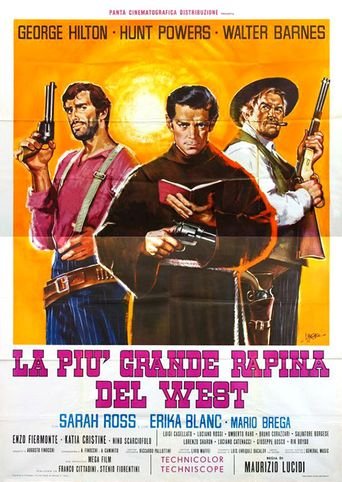
Hallelujah for Django (La più grande rapina del West)

Hallelujah for Django (La più grande rapina del West) (translated)

Movie · 1967 · 15 people

Maurizio Lucidi directed Halleluja for Django, originally La più grande rapina del West ("The Greatest Robbery of the West"), a 1967 Italian spaghetti western with a screenplay by Augusto Caminito. It is regarded as one of the first spaghetti westerns to bring comic elements into its story. Shot in colour and in Italian, it runs roughly 107 to 115 minutes, depending on the listing.

George Hilton plays one of the leading roles. The cast also includes Jack Betts (Santo / David Phaylard), Erika Blanc (Jenny), Mario Brega (Andreas / Yanaro), Jeff Cameron, Walt Barnes, Enzo Fiermonte, Luciano Rossi and Sal Borgese.

The film was released in the United States as Halleluja for Django and in Great Britain as The Greatest Kidnapping in the West; in France it is Trois salopards, une poignée d'or, in Spanish-speaking countries El robo más grande del Oeste and in Brazil Aleluia para Django - A Grande Rapina do Oeste. It reached German cinemas only on 6 March 1970. Critics praised its strong story and good tension but found its giallo side weak.

DirectorMaurizio Lucidi

Reactions

You can pick up to 3 reactions.

Cast

Names without a link have no profile here yet.

Erika Blanc Erika Blanc Actor · 84 years old Jenny Sal Borgese Sal Borgese Actor · 89 years old Jarrett Gang George Hilton (oyuncu) Mario Brega Mauro Bosco Walt Barnes Jack Betts Jeff Cameron Enzo Fiermonte Tom Felleghy Katia Christine Luciano Catenacci Luciano Rossi Umberto Raho Valentino Macchi

Through different eyes

Action & Thriller Fan Puts pace, tension and set pieces first; little patience for slow drama.

Say spaghetti western and I think dust, guns and tense stare-downs; this one throws comedy into the mix as well. If the tension the critics praised really delivers, the robbery idea promises a fast-moving evening. Having George Hilton in the lead makes it worth a look too. Still, it helps to know the giallo side was judged weak, so don't expect much from that part.

Cinephile Looks at script, editing and directing choices; keeps a distance from formula films.

Maurizio Lucidi's film sits at an interesting threshold in the genre's history. Being counted among the first spaghetti westerns to work comedy into the story, it reads as an early, still-fresh try at a formula that would later be watered down considerably. Augusto Caminito's script offers a story-and-tension framework that critics found strong. The trouble is that the film winks at several genres at once, and its weak giallo side shows the tonal balance doesn't always hold. Running times varying between 107 and 115 minutes across listings also suggest different cuts in circulation; for genre devotees its historical value may outweigh its merits as a coherent work.

These are not reader reviews: they are short editorial takes written from different viewer perspectives with AI assistance. Reader reviews are below.

Reviews (0)

Log in Log in to write a review.

Comments