Diaz – Don't Clean Up This Blood

Diaz – Don't Clean Up This Blood

Movie · 2012 · 15 people

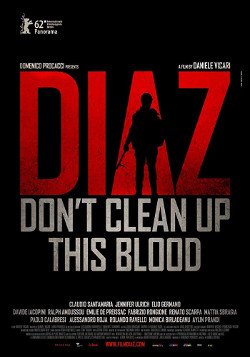
Set during the much-discussed last days of the 2001 G8 summit in Genoa, Daniele Vicari's 2012 drama Diaz – Don't Clean Up This Blood centres on the police raid on the Armando Diaz school, where protesters from the summit were staying. Italy, France and Romania produced it jointly. Shown in the Panorama section of the 2012 Berlin Film Festival, it won the section's second audience prize.

On the night of 21 to 22 July 2001, more than three hundred police officers entered the school, which held both activists and journalists. Sixty-one people were seriously injured and one fell into a coma. The film tells that night from the view of both the protesters and the police. The cast includes Claudio Santamaria (Max Flamini), Jennifer Ulrich (Alma Koch), Elio Germano (Luca Gualtieri), Davide Iacopini (Marco) and Renato Scarpa. The events are often described as among the worst human rights violations in Europe since the Second World War.

Vicari wrote the script with Laura Paolucci, drawing on court files and conversations with eyewitnesses. The officers' trials lasted eleven years, delaying the film. The school was rebuilt in Bucharest, and shooting began in June 2011 in Bucharest, Genoa and South Tyrol. Fandango and Le Pacte produced it.

DirectorDaniele Vicari
Production companyFandango

Reactions

You can pick up to 3 reactions.

Cast

Names without a link have no profile here yet.

Renato Scarpa Renato Scarpa Actor · died at 82 Anselmo Vitali Clara Vodă Clara Vodă Actor · 56 years old Daniela Tenuti Claudio Santamaria Jennifer Ulrich Elio Germano Davide Iacopini Ralph Amoussou Fabrizio Rongione Mattia Sbragia Antonio Gerardi Paolo Calabresi Francesco Acquaroli Alessandro Roja Rolando Ravello Monica Bîrlădeanu

Through different eyes

History & Society Lens Asks about the period, the social background and what the work reflects.

Diaz tells the story of a real police raid during the last days of the 2001 G8 summit in Genoa, events often described as among the worst human rights violations in Europe since the Second World War. Its social weight comes from a script built on court files and conversations with eyewitnesses, which gives the story the quality of testimony rather than mere fiction. That the officers' trials lasted eleven years, delaying the film, says something on its own: the process of accountability took far longer than the events themselves. Here cinema works as one of the ways public memory keeps its records.

Cinephile Looks at script, editing and directing choices; keeps a distance from formula films.

Vicari's defining choice is to build that night from the point of view of both the protesters and the police. This multiple perspective stops the event from shrinking into one hero's emotional journey and forces us to see the raid as the workings of a system rather than of individuals. It comes at a price: in a story split across so many characters, some figures are bound to stay on the surface, and the viewer never stays with anyone for long. Production decisions such as rebuilding the school in Bucharest show how much weight was placed on the authenticity of the setting. Its audience prize in the Berlin Panorama section signals that such a hard subject could still reach a wide audience.

Family Viewer Asks whether the whole household can watch it; cares about humour and heart.

This isn't a film to pick for a family evening. It is about a real police raid in which people were badly hurt: sixty-one were seriously injured and one fell into a coma. Don't watch it with children. If you watch it with older teens, explain what happened first and talk it through together afterwards. An important but shattering film for adults.

These are not reader reviews: they are short editorial takes written from different viewer perspectives with AI assistance. Reader reviews are below.

Reviews (0)

Log in Log in to write a review.

Comments