La criatura

La criatura

Movie · 1977 · 7 people

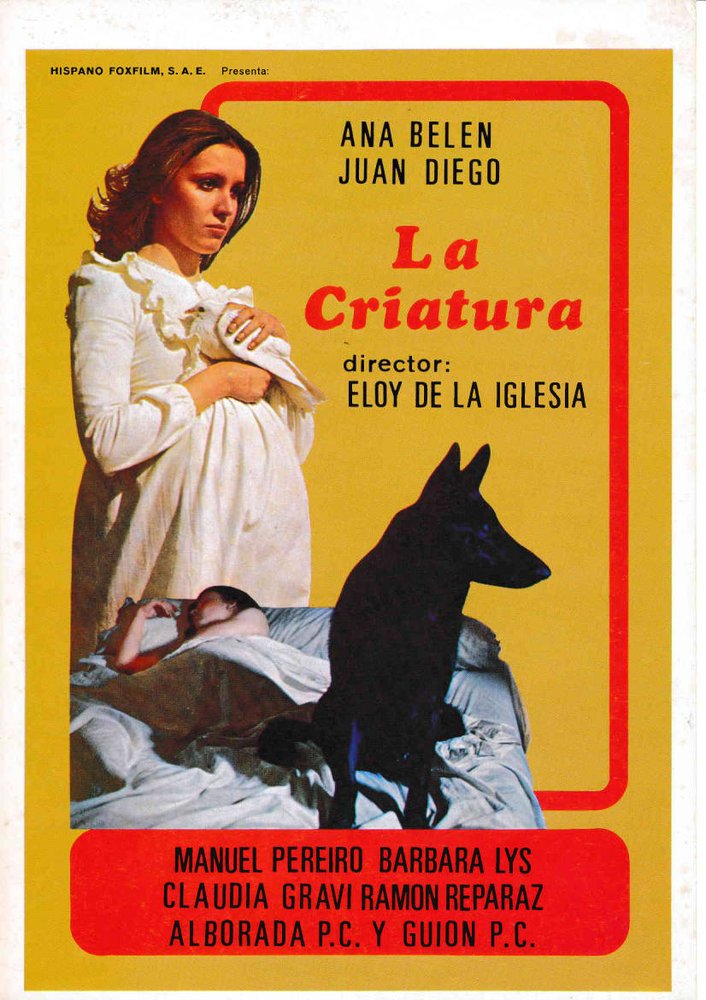
Eloy de la Iglesia directed La criatura (“The Creature”), a 1977 Spanish drama. Running about 100 minutes, it stirred controversy and was widely regarded as bizarre because of its subject. Its open treatment of sexual attraction to an animal was a novelty for Spanish cinema at the time, and it is counted among the first Spanish films to take the theme on. Walerian Borowczyk's La Bête (1975) and Nagisa Oshima's Max mon amour (1986) are mentioned alongside it for the same reason.

The story centres on a respectable bourgeois housewife in a monotonous, frustrating marriage that is heading for failure. She chooses her devotion to a black German Shepherd over her relationship with her husband. Ana Belén and Juan Diego play the leading roles, with Luis Ciges, Bárbara Lys, Ramón Reparaz, Antonio Gamero and Claudia Gravy also in the cast. Enrique Barreiro wrote the screenplay.

The film draws attention not only for its startling subject but also for its political references. Shot in 1977, it uses the relationship with the animal as a symbol of Spain's political landscape and alludes to the Atocha massacre and to the far-right groups that, after Franco's death, tried to keep the dictator's political ideals alive.

DirectorEloy de la Iglesia

Reactions

You can pick up to 3 reactions.

Cast

Names without a link have no profile here yet.

Juan Diego Juan Diego Film actor · died at 79 Claudia Gravy Claudia Gravy Actor · 81 years old Ana Belén Ramón Reparaz Bárbara Lys Luis Ciges Antonio Gamero

Through different eyes

Cinephile Looks at script, editing and directing choices; keeps a distance from formula films.

What makes La criatura interesting is less its provocative subject than what it turns that subject into. Eloy de la Iglesia does not leave the attraction to an animal as mere scandal; he makes it the vehicle of a political allegory. It is easy to see why it is named alongside Borowczyk's La Bête and Oshima's Max mon amour, but the real concern here is politics, not taboo. The trouble is that the symbol weighs so heavily that the housewife's inner life is at times reduced to a carrier for an idea, and the balance between drama and allegory does not always hold. That choice gives the film nerve but costs it subtlety. Valuable as an experiment that pushed the limits of Spanish cinema at the time; debatable as a fully rounded film.

History & Society Lens Asks about the period, the social background and what the work reflects.

The film should be read together with when it was made: right after Franco's death, in years when Spain was searching for a direction. The stifled bourgeois marriage and the woman's devotion to the animal are built as a symbol of the country's political landscape, and the allusions to the Atocha massacre and to the far-right groups trying to keep the dictator's ideas alive clearly support that reading. For a viewer who does not know this context, though, the references can easily slip past, leaving only a strange scandal story. A little background on the period lets you see the film from a completely different angle. An interesting document for anyone trying to understand Spain in the late 1970s.

Family Viewer Asks whether the whole household can watch it; cares about humour and heart.

This is not a family film. Its subject is a woman's sexual attraction to her dog, and it deals with that openly. It is not something to sit down and watch with children, teenagers or grandparents. Its political references may be interesting, but that is a choice for adults to make on their own, knowing what they are getting into. If you want a film for a family evening, pick something else.

These are not reader reviews: they are short editorial takes written from different viewer perspectives with AI assistance. Reader reviews are below.

Reviews (0)

Log in Log in to write a review.

Comments