Snow (Snijeg)

Snow (Snijeg)

Movie · 2008 · 5 people

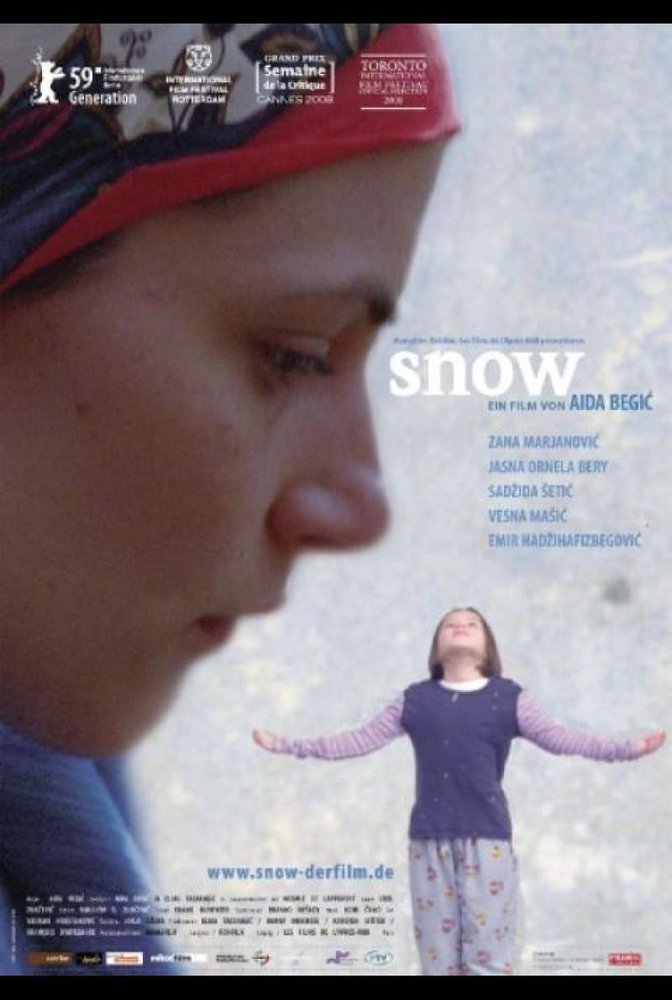
Snijeg, known in English as Snow and in Turkey as Kar, is Aida Begić's 2008 debut feature. A drama co-produced by Bosnia and Herzegovina, France and Germany, it was shot in Bosnian and runs 99 minutes. Begić wrote the script with Elma Tataragić. The film screened in the International Critics' Week programme of the 61st Cannes Film Festival and won that section's award. It was Bosnia and Herzegovina's entry for Best Foreign Language Film at the 81st Academy Awards that year but missed the shortlist. It opened in Turkey on 7 November 2008.

The story is set in 1997, after the war that tore Yugoslavia apart, in Slavno, a war-damaged Bosnian village where the wounds are slowly healing. The villagers have not got over the shock: their families were killed and the bodies never found. They have made a private world in which their loved ones still exist, turning the village into a place of imagination. As the threat of snow approaches, a young woman, Alma (Zana Marjanović), thinks she has found a way for them to survive, even to prosper. Two businessmen who suddenly appear complicate matters further.

Zana Marjanović plays Alma, Jasna Beri is Nadija, Sadžida Šetić is Jasmina and Emir Hadžihafizbegović plays Dedo. Jasmin Geljo is also in the cast.

DirectorAida Begić

Reactions

You can pick up to 3 reactions.

Cast

Names without a link have no profile here yet.
Through different eyes

History & Society Lens Asks about the period, the social background and what the work reflects.

Snow is about a moment when the war is over but the mourning is not. Set in 1997, it shows how people whose loved ones' bodies were never found live their lives in suspension; the imaginary world the villagers have built is like the social face of a wound that has not closed. The two businessmen who suddenly turn up are a reminder of how outsiders can shake such a fragile order. An important film for anyone who wants to follow Bosnia's recent history not through headlines but through the daily life of a village. It offers a quiet but powerful testimony on loss, waiting and getting back on one's feet.

Cinephile Looks at script, editing and directing choices; keeps a distance from formula films.

In her debut Aida Begić chooses to convey grief not head-on but through the imaginary world the villagers have built. The approach gives the film a poetic tone and keeps it from being a plain lament. Its Critics' Week award at Cannes shows that this bold choice paid off. But the deliberately blurred line between reality and imagination makes the storytelling hazy in places, and the poetic distance at times risks turning the characters into symbols. A debut that asks a lot of a patient viewer and repays it.

Family Viewer Asks whether the whole household can watch it; cares about humour and heart.

This film handles a heavy subject: people who lost their families in the war and never even found their loved ones' bodies. It is about the aftermath more than the war itself, but it is still too heavy and slow for young children. Watched with high-school-age teenagers, it can be a good starting point for talking about recent history. Not for anyone after a light family evening.

These are not reader reviews: they are short editorial takes written from different viewer perspectives with AI assistance. Reader reviews are below.

Reviews (0)

Log in Log in to write a review.

Comments