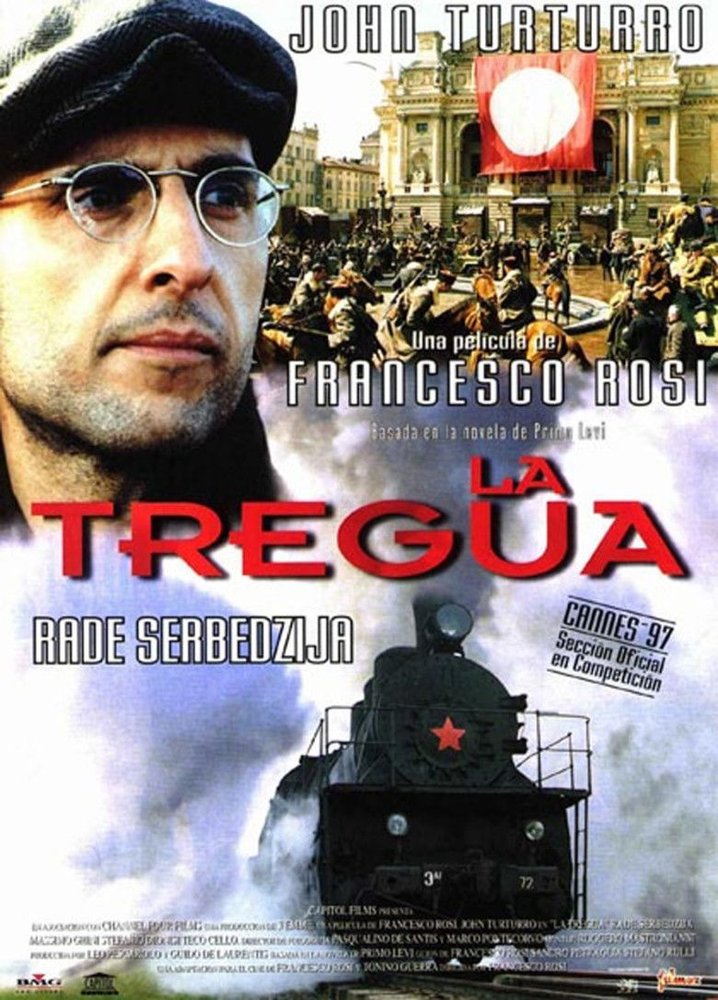
The Truce (La tregua)

The Truce (La tregua)

Movie · 1997 · 15 people

Francesco Rosi directed La tregua (The Truce), a 1997 drama and war film. It is adapted from Primo Levi's autobiographical account of the same name, a book that won the Campiello Prize. Shot in Italian, the film runs about 125 minutes and is known as Rosi's last film. John Turturro stars.

The film recounts Levi's journey back to Italy in 1945, after the Red Army liberated the Auschwitz concentration camp at the end of the Second World War. The survivor crosses a devastated Europe by a long and winding route, meeting others who have come out of the camps, and the journey becomes an inner recovery as much as a physical return. Alongside Turturro the cast includes Massimo Ghini, Rade Šerbedžija, Claudio Bisio, Andy Luotto, Teco Celio, Stefano Dionisi, Franco Trevisi, Roberto Citran and Lorenza Indovina.

Rosi wrote the screenplay with Stefano Rulli and Sandro Petraglia, and Tonino Guerra prepared the story treatment. The co-production between Italy, France and Germany, with Switzerland also named among its partners, filmed in Turin and Ukraine. Capitol Films and 3 Emme Cinematografica are among the production companies. The film was part of the official selection at the 1997 Cannes Film Festival and won the David di Donatello awards for Best Film and Best Director.

DirectorFrancesco Rosi
Production companyCapitol Films

Reactions

You can pick up to 3 reactions.

Cast

Names without a link have no profile here yet.

Roberto Citran Roberto Citran Actor · 71 years old Unverdorben Lorenza Indovina Lorenza Indovina Actor · 60 years old Flora John Turturro Massimo Ghini Rade Šerbedžija Claudio Bisio Andy Luotto Teco Celio Agnieszka Wagner Aleksandr Ilyin Anatoly Vasilyev Stefano Dionisi Ihor Chernytskyi Gerda-Maria Jürgens Franco Trevisi
Through different eyes

Cinephile Looks at script, editing and directing choices; keeps a distance from formula films.

Rosi's last film faces the difficulty of bringing a source with the literary weight of Primo Levi to the screen. Levi's account of his return rests less on events than on the slow recovery of an inner life, and turning that into images means trusting a road-movie structure. The encounters along the way are both the strength and the weakness of that structure: in my view some stops come alive, while others seem to do little more than lengthen the journey. Casting an American actor as the lead in a film shot in Italian is also a debatable choice. Still, the David di Donatello awards for Best Film and Best Director show it was taken seriously in Italy.

History & Society Lens Asks about the period, the social background and what the work reflects.

The film focuses on a moment that Holocaust stories tend to treat less often: the day after liberation. The journey of survivors trying to cross a Europe devastated by war, after the liberation of Auschwitz, is a reminder that the end of the war did not mean an end for everyone at the same moment. The way people who came out of the camps hold on to one another along the road shows how a sense of community can be rebuilt after destruction. Being based on Primo Levi's own autobiographical account brings the film close to a document of memory, which also makes it a valuable starting point for teaching history.

Family Viewer Asks whether the whole household can watch it; cares about humour and heart.

A heavy but hopeful film about a Holocaust survivor's journey home. The subject is too heavy for young children; it's better watched with high-school-age teens, with the family talking it through. It can work well for teenagers who would rather learn history from one person's story than from a textbook. Don't expect the battle scenes that "war film" might suggest; this is a story of a journey and of recovery.

These are not reader reviews: they are short editorial takes written from different viewer perspectives with AI assistance. Reader reviews are below.

Reviews (0)

Log in Log in to write a review.

Comments