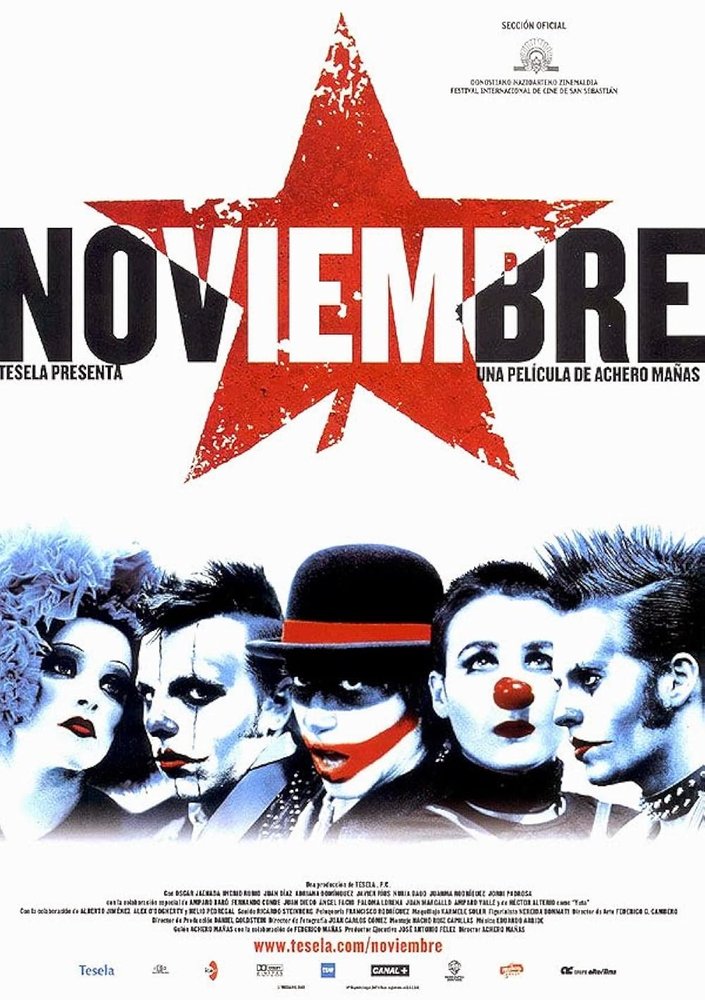
November (Noviembre)

November (Noviembre) (translated)

Movie · 2003 · 15 people

Achero Mañas directed Noviembre (November), a Spanish film from 2003, and shared the writing credit on its screenplay. It is in Spanish and lasts roughly 104 minutes. Shot as a mockumentary about a street theatre company of the same name, it sits somewhere between drama and comedy. Its timeline runs from 1997 to 2040, a wide span that lets it follow the troupe's journey and how its ideals are tested.

At the centre is Alfredo, a young man who believes art can change the world and goes to Madrid to create a free performance that makes people feel alive. Joining forces with like-minded friends, he forms the theatre company Noviembre, the Spanish word for November. The troupe performs in squares, parks and streets across the city. Refusing payment for its shows is its core principle, and its greatest aim is to make the public part of the play.

The film explores the relationship between spectators and performers, the commercialisation of art and the revolutionary potential of theatre. Its cast includes Óscar Jaenada, Ingrid Rubio, Juan Díaz, Javier Ríos, Núria Gago, Adriana Domínguez, Juanma Rodríguez and Jordi Padrosa, together with Juan Diego, Pedro Alonso, Héctor Alterio and Amparo Baró.

DirectorAchero Mañas

Reactions

You can pick up to 3 reactions.

Cast

Names without a link have no profile here yet.

Juan Diego Juan Diego Film actor · died at 79 Pedro Alonso Pedro Alonso Actor · 55 years old Ingrid Rubio Juan Díaz Pardeiro Óscar Jaenada Héctor Alterio Amparo Baró Núria Gago Amparo Valle Javier Ríos Alberto Ferreiro Petra Martínez Jesús Olmedo Alfonso Torregrosa Helio Pedregal
Also in the cast: Juan Díaz, Adriana Domínguez, Juanma Rodríguez, Jordi Padrosa

Through different eyes

Cinephile Looks at script, editing and directing choices; keeps a distance from formula films.

Achero Mañas's smartest decision is to tell the story of a street theatre troupe as a mockumentary. Stretching the timeline from 1997 to 2040 lets the film look back on its own heroes, so their idealism is both told and put to the test. In my view the form has a cost, though: the documentary frame, while chasing the spontaneity of the performances, sometimes keeps the viewer at arm's length, and the shifts between drama and comedy are not always smooth. Even so, it is consistent for a film about the commercialisation of art to choose a modest, low-key form. An interesting case for anyone who likes formal experiments.

History & Society Lens Asks about the period, the social background and what the work reflects.

The question Noviembre asks reaches well beyond its own time: can art survive outside the market? A troupe that refuses payment on principle treats art not as a commodity but as a public gathering, turning squares, parks and streets into stages. That means thinking of the city as a space for shared experience, not only for consumption. The idea of making the audience part of the play also challenges the hierarchy between spectator and artist. Watching how such ideals are tested over time is a good prompt for thinking about values that shift between generations.

Family Viewer Asks whether the whole household can watch it; cares about humour and heart.

A film about street theatre, ideals and art's relationship with money. It is not one for small children; the mockumentary style and the themes will feel too abstract to them. It can work with teenagers who are into theatre or a school drama club, and it leaves plenty to talk about afterwards. It is in Spanish, so subtitles are needed, and it is worth checking the content before a family viewing.

These are not reader reviews: they are short editorial takes written from different viewer perspectives with AI assistance. Reader reviews are below.

Reviews (0)

Log in Log in to write a review.

Comments