Death in Sarajevo (Smrt u Sarajevu)

Death in Sarajevo (Smrt u Sarajevu)

Movie · 2016 · 3 people

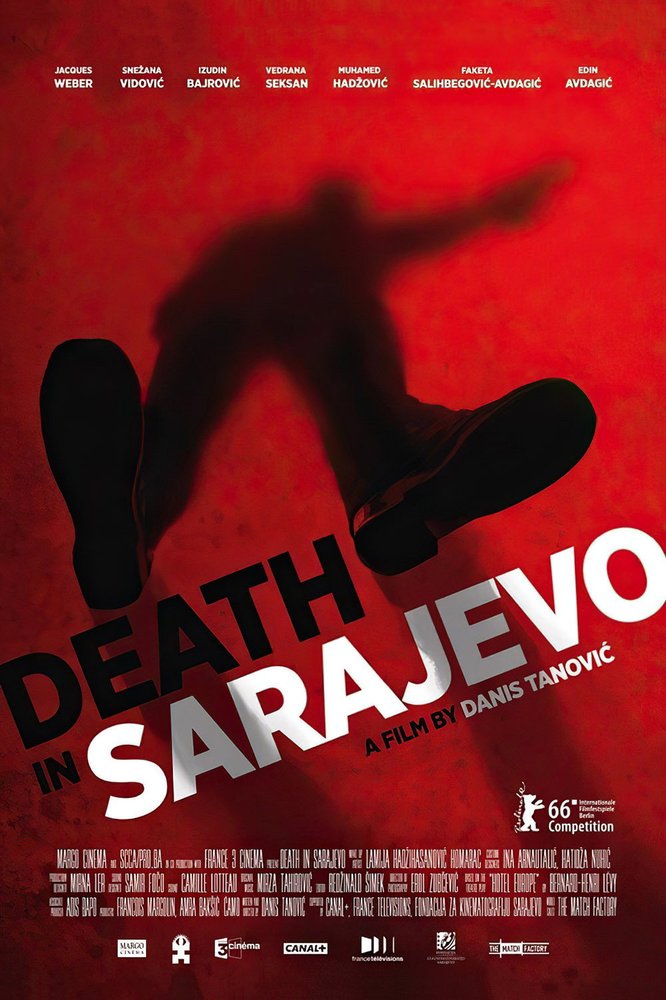
Bosnia and Herzegovina and France co-produced Death in Sarajevo, a 2016 drama that Danis Tanović wrote and directed. It adapts the stage play Hotel Europe by the French philosopher Bernard-Henri Lévy and packs the existential fears and moral dilemmas of modern Europe into a single hotel. The producers are SCCA/pro.ba of Sarajevo, headed by Amra Bakšić Čamo, and Margo Cinema of Paris. The film was chosen to compete for the Golden Bear at the 66th Berlin International Film Festival, where it won the Jury Grand Prix and the FIPRESCI prize.

The action takes place on 28 June 2014, a hundred years after the assassination that set off the First World War, in the famous Hotel Europe. As the hotel prepares for a commemoration, a rooftop television broadcast suddenly revives century-old arguments. Staff unpaid for months want to strike on this very day; the manager tries to stop them by his own methods, and strike spokesmen vanish one by one. The policeman guarding an important guest worries mainly about the price of a sofa. The cast includes Jacques Weber, Snezana Markovic and Izudin Bajrović.

Running about 85 minutes, it was Bosnia and Herzegovina's entry for Best Foreign Language Film at the 89th Academy Awards but did not receive a nomination.

DirectorDanis Tanović
Production companySCCA/pro.ba, Margo Cinema

Reactions

You can pick up to 3 reactions.

Cast

Names without a link have no profile here yet.
Also in the cast: Snezana Markovic
Through different eyes

Cinephile Looks at script, editing and directing choices; keeps a distance from formula films.

Adapting Bernard-Henri Lévy's play, Danis Tanović confines the action to a single hotel and turns that constraint into an asset: the rooftop TV broadcast, the staff preparing to strike and the manager's manoeuvres run through one day as parallel lines that keep brushing against each other. Setting a century-old historical debate beside a hotel's everyday troubles is a bold structural choice, and details such as the policeman worried about the price of the sofa his wife wants weigh the big questions with ironic distance. The Jury Grand Prix and the FIPRESCI prize in Berlin show the design paid off. Still, in my view its stage origins show too clearly at times: the rooftop debates flow more like spoken text than cinema.

History & Society Lens Asks about the period, the social background and what the work reflects.

The film marks the centenary of the assassination that triggered the First World War not only through a commemoration but through the strike being prepared by hotel staff who have gone unpaid for months. The choice is telling: while grand debates about history go on, ordinary people's money troubles play out in the same building. That unchanged political positions can still flare up in a TV broadcast a hundred years on suggests the past remains an open account in the region. As one critic wrote, the film argues that twentieth-century European history began and ended in Sarajevo; some may find that claim overstated, but the questions it raises are still current.

Action & Thriller Fan Puts pace, tension and set pieces first; little patience for slow drama.

Strike spokespeople vanishing one by one, an important guest under police protection, all on a single day: on paper, that is tension. But Death in Sarajevo is no thriller; it is a patient drama built on conversations in corridors and rooms. If you are after pace and thrills, it may feel heavy. If you like a tight, single-location atmosphere, give it a chance.

These are not reader reviews: they are short editorial takes written from different viewer perspectives with AI assistance. Reader reviews are below.

Reviews (0)

Log in Log in to write a review.

Comments