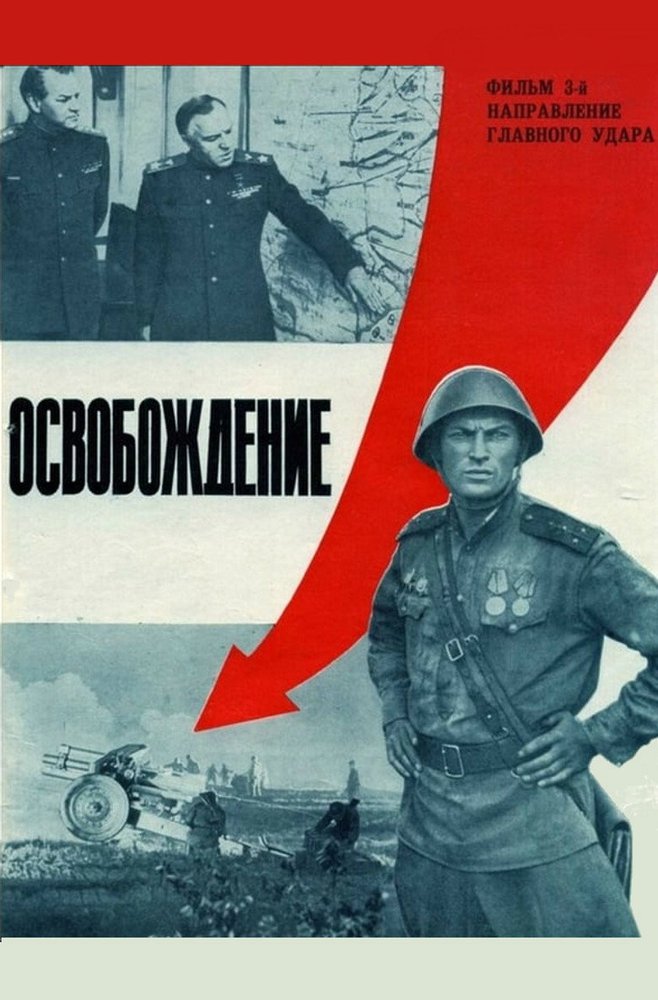
Liberation (Osvobozhdeniye)

Liberation (Osvobozhdeniye)

Movie · 1970–1971 · 15 people

Yuri Ozerov directed Liberation (Russian Osvobozhdenie, German Befreiung), a Soviet war epic in five feature-length films. Released in 1970 and 1971, it was shot in the 70 mm wide-format NIKFI process and co-produced by the Soviet Union, Poland, East Germany, Italy and Yugoslavia. It runs about seven and a half hours in all. The first part was finished in 1970 to mark the 25th anniversary of victory, and the series was selected as the Soviet entry for the 1971 Academy Awards.

The series dramatizes the stretch of the Great Patriotic War from the summer of 1943 to the capture of Berlin in 1945, from the liberation of Soviet territory to the defeat of Nazi Germany, through five Eastern Front campaigns: the Battle of Kursk, the Lower Dnieper Offensive, Operation Bagration, the Vistula-Oder Offensive and the Battle of Berlin. More than fifty historical figures appear. The five parts are titled Fire Arc, Breakthrough, Direction of the Main Blow, Battle for Berlin and The Last Assault.

Yuri Bondarev and Oskar Kurganov wrote the script. Besides Mosfilm, studios from Poland, East Germany, Italy and Yugoslavia took part, and the dialogue is in Russian and German. The cast includes Mikhail Ulyanov, Vasily Shukshin, Nikolay Olyalin, Larisa Golubkina and Fritz Diez. Filming began in the late 1960s.

DirectorYuri Ozerov
Production companyMosfilm

Reactions

You can pick up to 3 reactions.

Cast

Names without a link have no profile here yet.

Vsevolod Sanayev Vsevolod Sanayev Actor · died at 83 Vladimir Samoylov Vladimir Samoylov Actor · died at 75 Nikolay Olyalin Larisa Golubkina Boris Seidenberg Mihail Ulyanov Vasily Shukshin Fritz Diez Angelika Waller Horst Giese Gerd Michael Henneberg Werner Dissel Hannjo Hasse Rolf Ripperger Alfred Struwe
Through different eyes

Action & Thriller Fan Puts pace, tension and set pieces first; little patience for slow drama.

Five films, about seven and a half hours, and five major operations from Kursk to Berlin: you'll struggle to find anything bigger in scale. A war epic shot in 70 mm widescreen promises a real visual feast on paper. But seven and a half hours is a serious commitment, and watching it all back to back brings more fatigue than fresh tension. The smartest way is to treat each film as its own operation and watch them with breaks in between.

History & Society Lens Asks about the period, the social background and what the work reflects.

Liberation is best read not as a history lesson but as a record of a period's official memory. Finishing the first part in time for the 25th anniversary of the victory shows plainly that the film was designed as an act of commemoration. Building the Great Patriotic War as a victory march from the liberation of Soviet territory to Berlin reflects how the Soviet Union wanted to tell its own past at the start of the 1970s. Having Poland and East Germany among the co-producers also suggests a wish, in those years, to turn the memory of the war into a shared narrative. It is valuable for grasping the scale of the Eastern Front, but it should be watched with its selective, heroism-centred view in mind.

Cinephile Looks at script, editing and directing choices; keeps a distance from formula films.

Ozerov's project is an interesting case study in how to structure an epic: five films, each built around a separate operation, move along a chronological spine, and that division gives the narrative room to breathe. The 70 mm format gives the crowded battle shots the space they need, and completing a production of this size with a shoot running from the late 1960s into 1971 is a logistical feat in itself. Its weak point is dramaturgy: in a story that brings more than fifty historical figures to the screen, there is little room for characters to deepen, and at times the script settles for illustrating a chronology. An impressive panorama, but it may not satisfy anyone looking for character-driven cinema.

These are not reader reviews: they are short editorial takes written from different viewer perspectives with AI assistance. Reader reviews are below.

Reviews (0)

Log in Log in to write a review.

Comments