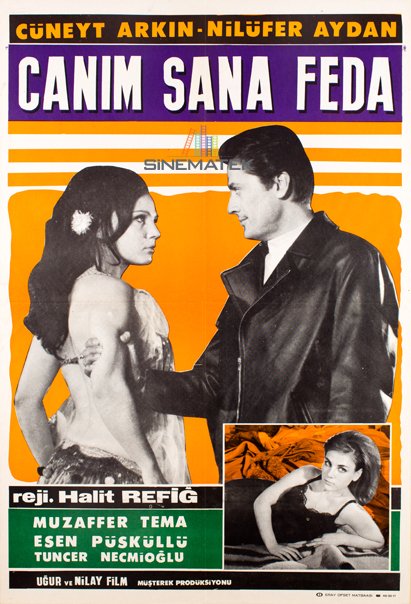
I Would Give My Life for You (Canım Sana Feda)

I Would Give My Life for You (Canım Sana Feda) (translated)

Movie · 1965 · 17 people

The black-and-white Turkish melodrama Canım Sana Feda ("My Life for You") dates from 1965. Halit Refiğ directed it from a screenplay by Safa Önal. It belongs to the popular romantic-drama tradition of 1960s Turkish cinema, treating sacrifice, sisterhood and love under poverty against the backdrop of the nightclub world.

Set in Istanbul, the story centres on Türkan Ateş, orphaned young and working as a dancer at the Cennet Pavyon to put her younger sister Sibel through boarding school. Ahmet, a truck driver, defends her from men who pester her in the street and falls for her. He wants her to give up dancing, but Türkan will not agree until Sibel has finished school, and the quarrel strains their love. Then Cevdet Tekin, a wealthy haulage-company owner, enters the picture, and events race towards tragedy.

Cüneyt Arkın plays Ahmet, Nilüfer Aydan is Türkan, Muzaffer Tema is Cevdet Tekin and Esen Püsküllü is Sibel. Uğur Film and Nilay Film made the picture; Memduh Ün and Halit Refiğ produced it, Gani Turanlı and Mustafa Yılmaz shared the cinematography, and Rauf Tözüm composed the music.

DirectorHalit Refiğ
Production companyUğur Film, Nilay Film

Reactions

You can pick up to 3 reactions.

Cast
Through different eyes

Yeşilçam Nostalgic A viewer raised on the classics, looking for warm storytelling and strong acting.

Bearing the names of Halit Refiğ and Safa Önal, this film draws on the most precious vein of Yeşilçam melodrama: an elder sister who devotes herself to her younger sibling. The wooden-house neighbourhood of a black-and-white Istanbul lends the story a warmth that is hard to find today. Türkan placing her sister's future above her own love gives the film a firm moral centre. The nightclub here is not a place of vice but of a necessity forced by poverty, and to my mind that is the film's real subtlety. With Rauf Tözüm's music alongside, it is a precious stop for anyone who misses the heartfelt storytelling of the old masters.

Cinephile Looks at script, editing and directing choices; keeps a distance from formula films.

The script lays down the familiar stones of Yeşilçam melodrama one by one: the orphaned heroine, the self-sacrificing sister, the lover who wants her to stop dancing and the rich man who upsets the balance. The early conflict, between Ahmet's demand and Türkan's duty to her sister, poses a genuine dramatic question, and the film is at its strongest there. Once the wealthy haulage owner steps in, the story speeds up and rushes towards tragedy; the characters lose room to breathe and coincidence takes the place of psychology. Gani Turanlı and Mustafa Yılmaz's black-and-white photography makes the neighbourhood texture precious. A solid example for genre devotees, but too familiar for anyone after a melodrama that breaks the mould.

History & Society Lens Asks about the period, the social background and what the work reflects.

The film shows plainly how women's work, education and honour were bound together in 1960s Istanbul. Türkan earns her living in a nightclub so that her sister can study at a girls' boarding school; education is seen as almost the only way out of poverty. Ahmet's demand that she stop dancing reflects the period's male view of women working. A truck driver and a haulage-company owner standing at opposite ends of the same trade also builds class difference right into the story. And the wooden-house neighbourhood opens a small window onto the city before its rapid transformation.

These are not reader reviews: they are short editorial takes written from different viewer perspectives with AI assistance. Reader reviews are below.

Reviews (0)

Log in Log in to write a review.

Comments