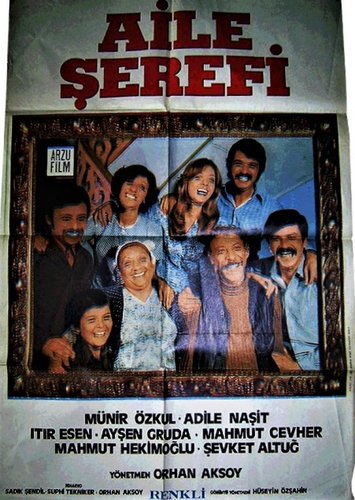
Family Honor (Aile Şerefi)

Family Honor (Aile Şerefi) (translated)

Movie · 1976 · 17 people

Orhan Aksoy directed Aile Şerefi ("Family Honor"), a 1976 Yeşilçam family drama with a screenplay by Sadık Şendil, Suphi Tekniker and Aksoy. Made by Arzu Film in colour on 35 mm, it runs roughly an hour and a half, and its producers include Nahit Ataman and Ertem Eğilmez. It builds an emotional family story around poverty, dignity and solidarity.

At its heart is Rıza, played by Münir Özkul, who scrapes a living selling mineral water from a horse-drawn cart. Adile Naşit appears as Emine, the mother. The couple have five children: Selim (Mahmut Hekimoğlu) studies medicine, Hasan (Mahmut Cevher) works in a factory and Zeynep (Itır Esen) in a garment workshop. When their newly married daughter Ayşe (Ayşen Gruda) and her street-vendor husband Zihni (Şevket Altuğ) move in, the household budget is squeezed further, and the family is thrown into crisis when a car strikes Murat, the youngest son, a middle-schooler. The car belongs to Oktay (Eriş Akman), the son of a wealthy family, and matters escalate when he abducts Zeynep; the poor family closes ranks to defend its honor.

Hüseyin Özşahin handled the photography and Melih Kibar composed the music. Betül Aşçıoğlu, Muhip Arcıman and Selim Naşit are also in the cast.

DirectorOrhan Aksoy
Production companyArzu Film

Reactions

You can pick up to 3 reactions.

Cast

Through different eyes

Yeşilçam Nostalgic A viewer raised on the classics, looking for warm storytelling and strong acting.

With the Arzu Film name and Ertem Eğilmez among the producers, you expect a crowded, poor but proud household and the solidarity that grows inside it, and the film delivers. Münir Özkul as a father selling mineral water from a horse-drawn cart and Adile Naşit as the mother rebuild one of Yeşilçam's best-loved family pictures. Melih Kibar's music rounds out the warmth. The story's moral centre is plain: even in want, a person's dignity is not up for bargaining. A heartfelt choice for anyone who misses the classic family dramas.

History & Society Lens Asks about the period, the social background and what the work reflects.

The film draws a poor working family of the 1970s in concrete terms: a father who sells from a cart, children working in a factory and a garment workshop, a son studying medicine and a newly married couple moving in. The picture captures a time when education was seen as the main way up and a thin income had to carry a crowded household. Its weakness is that the class conflict is set up too much in black and white, with the wealthy side positioned mostly as a threat. Defining 'family honour' through what happens to a young woman also carries the outlook of its era, and today's viewers will read it with a critical eye.

Family Viewer Asks whether the whole household can watch it; cares about humour and heart.

This film is about a family sticking together, but it's worth knowing before you watch with young children: the youngest son is hit by a car, and later the family's daughter is abducted. Those are heavy events for little ones. On the other hand, its message about hard work, honesty and standing by each other is very strong. For children of middle-school age and up, parents and grandparents, it's one to watch together and talk about.

These are not reader reviews: they are short editorial takes written from different viewer perspectives with AI assistance. Reader reviews are below.

Reviews (0)

Log in Log in to write a review.

Comments