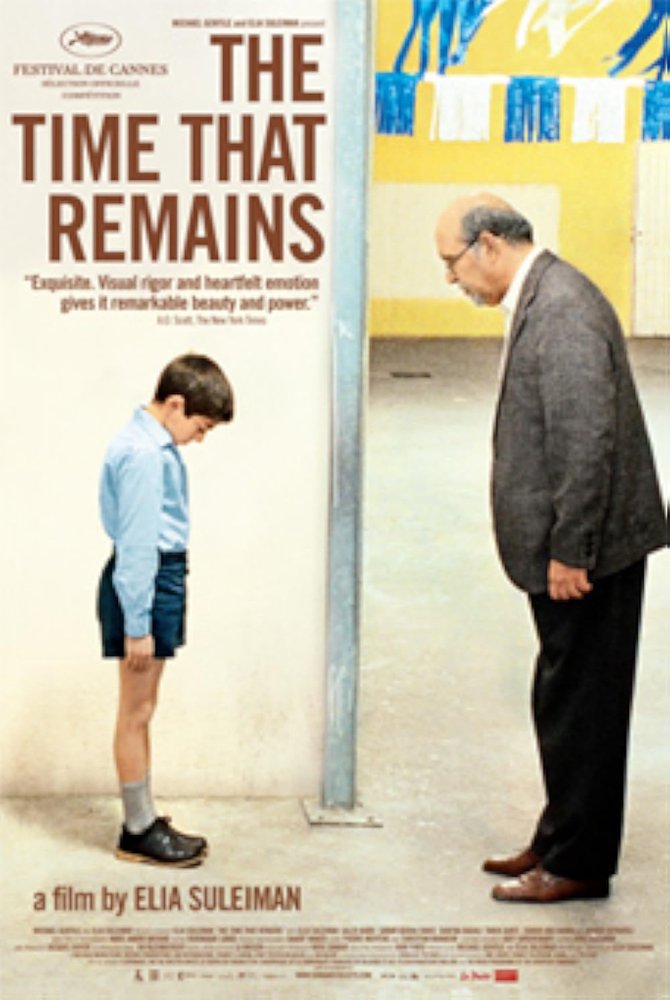
The Time That Remains

The Time That Remains

Movie · 2009 · 10 people

Palestinian filmmaker Elia Suleiman wrote and directed The Time That Remains: Chronicle of a Present Absentee, a semi-autobiographical drama from 2009 that recounts Palestinian life under Israeli occupation; the short form of its title is The Time That Remains. France, Israel and Italy co-produced the 109-minute film, with Belgian and British participation cited by other sources, and its dialogue is in English, Arabic and Hebrew.

The narrative reaches back to 1948, the Palestinian Nakba and the founding of the state of Israel. Suleiman tells of the upheaval that struck Nazareth that year through his own family and life, drawing on the diaries in which his father recorded the war days and what followed. The cast features Ali Suliman, Elia Suleiman, Saleh Bakri and Samar Qudha Tanus, together with Tarik Kopty, Amer Hlehel, Doraid Liddawi, Ziad Bakri, Menashe Noy, Nathan Ravitz and Maisa Abd Elhadi.

The film competed in the official selection at the Cannes Film Festival in May 2009 and was also screened at the Toronto International Film Festival that year. In November 2009 it shared the Jury Grand Prize at the Asia Pacific Screen Awards with About Elly. At the Mar del Plata International Film Festival it won the Critics Prize of the Argentinian Film Critics Association.

DirectorElia Suleiman

Reactions

You can pick up to 3 reactions.

Cast

Names without a link have no profile here yet.
Ali Süleyman Ali Süleyman Actor · 49 years old Eliza's Boyfriend Tarik Kopty Tarik Kopty Actor · died at 77 Neighbour Elya Süleyman Amer Hlehel Doraid Liddawi Saleh Bakri Ziad Bakri Menashe Noy Nathan Ravitz Maisa Abd Elhadi

Also in the cast: Ali Suliman, Elia Suleiman, Samar Qudha Tanus
Through different eyes

Cinephile Looks at script, editing and directing choices; keeps a distance from formula films.

Working from his father's diaries, Suleiman shrinks a huge history down to the scale of one family and one town. That choice sets the film apart from the standard historical drama: as the story moves from 1948 into his own life, the director steps in front of the camera himself, deliberately blurring the line between narrator and witness. The subtitle's idea of the 'present absentee', someone both there and not there, seems to shape the film's form as well. The attention it drew, from the Cannes competition to the Asia Pacific Screen Awards, shows the approach landed. Still, viewers expecting a strong plot may find it fragmentary; the film sets out to record a way of existing rather than a chain of events.

History & Society Lens Asks about the period, the social background and what the work reflects.

The film approaches 1948, the year Palestinians call the Nakba and the year the state of Israel was founded, through the eyes of one family in Nazareth. Its choice to centre everyday life rather than grand political narratives matters: living under occupation becomes less a question of maps than of a house, a neighbourhood and memory passed between generations. Resting on the father's diaries places the film somewhere between oral history and personal testimony. So it is not a neutral documentary but openly the voice of a witness, and it should be read in that light. The mix of English, Arabic and Hebrew on screen also mirrors how entangled the region's reality is.

Family Viewer Asks whether the whole household can watch it; cares about humour and heart.

The film deals with heavy themes such as war, occupation and loss. It is not one for small children. Watched together with high-school-age teens, it can open a good conversation about the region's history. Three languages are spoken, so you will need subtitles, which makes it harder still for younger viewers. It suits a quiet evening with room to think.

These are not reader reviews: they are short editorial takes written from different viewer perspectives with AI assistance. Reader reviews are below.

Reviews (0)

Log in Log in to write a review.

Comments