My Prostitute Love (Vesikalı Yarim)

My Prostitute Love (Vesikalı Yarim)

Movie · 1968 · 14 people

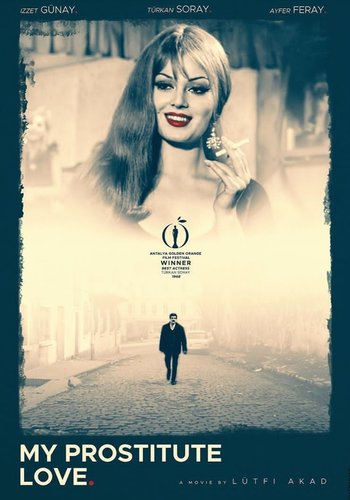
Ömer Lütfi Akad made the black-and-white Turkish drama Vesikalı Yarim in 1968. Telling a sorrowful love story in a distinctive cinematic language, it is counted among the classics of Turkish cinema. It won Best Second Film and Best Actress at the 1968 Golden Orange Film Festival, and a list announced by the Turkish film writers' association in 2015 placed it fifth among the best Turkish films. Its title comes from Orhan Veli's poem Tahattur.

The story follows the impossible love of Sabiha and Halil. Türkân Şoray plays Sabiha, who performs at the Şen Saz club in Beyoğlu, and İzzet Günay plays Halil, a young greengrocer who works with his father in Kocamustafapaşa. Out in Beyoğlu with friends, Halil sees Sabiha and cannot let go. He moves into her home and starts selling fruit on the street. The happiness does not last, as the prejudice around them, jealousy and violence strain the bond. Ayfer Feray and Behçet Nacar also appear.

Safa Önal adapted the screenplay from Menekşeli Vadi, a story in Sait Faik Abasıyanık's 1948 book Lüzumsuz Adam. Ali Uğur was the cinematographer and the music credits include Metin Bükey. A Şeref Film production of about 88 minutes, it later reached viewers on VCD and DVD.

DirectorÖmer Lütfi Akad
Production companyŞeref Film

Reactions

You can pick up to 3 reactions.

Cast

Through different eyes

Yeşilçam Nostalgic A viewer raised on the classics, looking for warm storytelling and strong acting.

Among the many Yeşilçam love stories that lean on tears, what sets Vesikalı Yarim apart is its restraint. Akad tells the impossible love of Sabiha and Halil not by shouting but through silence; the pain gathers in looks and pauses rather than grand speeches. That is why Türkân Şoray's Sabiha stays in the memory less as a melodrama heroine than as a fragile, dignified woman. For a lover of literature there is an extra pleasure: a film that takes its title from Orhan Veli and its story from Sait Faik brings the Istanbul of two great writers to the screen. It rewards a fresh viewing today, because its simplicity has not aged.

History & Society Lens Asks about the period, the social background and what the work reflects.

The film sets two worlds of the same city against each other: a young man who sells produce with his father in Kocamustafapaşa, and a woman who performs on stage in Beyoğlu. Halil moving into Sabiha's home and selling fruit on the street means crossing class and moral boundaries, and the prejudice around them shows how fiercely those boundaries are guarded. The pressure of respectability, neighbourhood and honour on personal feeling in 1960s Istanbul forms the story's real conflict. Akad builds that pressure through everyday detail rather than sermons, which is why the film can still be read as a social record of its time.

Cinephile Looks at script, editing and directing choices; keeps a distance from formula films.

Vesikalı Yarim became a classic because it uses the conventions of Yeşilçam melodrama while transforming them through film language. In my view Ali Uğur's black-and-white photography carries the contrast between Beyoğlu and the old neighbourhood with unforced simplicity, and Akad tells the conflict through framing and space more than dialogue. Safa Önal's adaptation of Sait Faik tightly gathers a short story around the rise and unravelling of a single relationship. Still, the film has not entirely escaped the production conditions of its era: some transitions feel hurried, and a few supporting characters never rise above a function. Despite these gaps, the economy of the storytelling and the direction of the actors make its place on the film writers' association list feel earned.

These are not reader reviews: they are short editorial takes written from different viewer perspectives with AI assistance. Reader reviews are below.

Reviews (0)

Log in Log in to write a review.

Comments