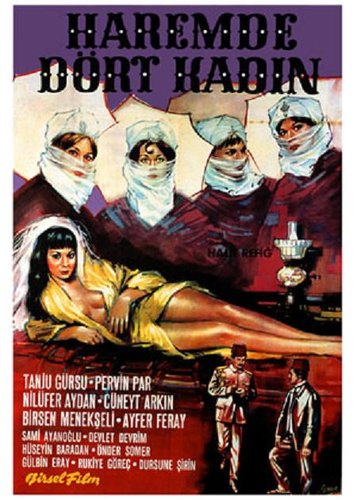
Four Women in the Harem (Haremde Dört Kadın)

Four Women in the Harem (Haremde Dört Kadın) (translated)

Movie · 1965 · 15 people

Halit Refiğ directed the black-and-white period drama Haremde Dört Kadın ("Four Women in the Harem"), made in 1965 from a screenplay he wrote with Kemal Tahir. Running about 83 minutes, it follows late Ottoman change through a pasha's household. It is regarded as one of the standout Turkish films of the 1960s, noted for its characters, dialogue and performances. With Atıf Yılmaz's İki Gemi Yanyana (1963), it is among the first Turkish films to show a relationship between women, which drew heavy criticism on release.

The story takes place in Istanbul in December 1899. Sadık Paşa (Sami Ayanoğlu), an official who presses foreign envoys' demands on the Sultan, has three wives but no child, and fears losing the Sultan's trust. In the mansion lives his nephew Cemal (Cüneyt Arkın), a young man about to finish medical school, who loves Ruhşan (Nilüfer Aydan), a distant relative; the Paşa, however, picks the girl as his fourth wife. In the harem, jealousy and secret attachments stir, above all between Şevkidil (Ayfer Feray) and Mihrengiz (Birsen Menekşeli), while Rüştü (Tanju Gürsu), the officer nephew the Paşa trusts, secretly works with his uncle's enemies. Pervin Par plays Gülfem.

The film was produced by Özdemir and Nüzhet Birsel for Birsel Film. Music is by Metin Bükey.

DirectorHalit Refiğ
Production companyBirsel Film

Reactions

You can pick up to 3 reactions.

Cast

Cüneyt Arkın Cüneyt Arkın Actor · died at 84 Dr. Cemal Tanju Gürsu Tanju Gürsu Film director · died at 77 Rüştü Nilüfer Aydan Pervin Par Sami Ayanoğlu Ayfer Feray Ayfer Feray Actor · died at 66 Şevkidil Birsen Menekşeli Gülbin Eray Hüseyin Baradan Devlet Devrim Rukiye Göreç Dursune Şirin Özdemir Akın Önder Somer Gani Turanlı


Through different eyes

History & Society Lens Asks about the period, the social background and what the work reflects.

The film tells the unravelling of the late Ottoman years by fitting it inside a pasha's mansion, and it does so very cleverly. Sadık Pasha, whose job is to get foreign envoys' demands accepted by the palace, shows how the outside balance of power seeps into the household. Cemal, about to graduate from medical school, stands for a new generation that resists the marriages the old order imposes. It is telling, too, that the film drew heavy criticism in its day for depicting relationships between women: it speaks not only about Istanbul in 1899 but also about the Turkey of the 1960s that argued over it.

Cinephile Looks at script, editing and directing choices; keeps a distance from formula films.

The screenplay Halit Refiğ wrote with Kemal Tahir turns the mansion into a closed stage, and the narrowness of the space becomes a dramatic tool for characters pressed up against one another. The dialogue is written with literary care, and the black-and-white photography lends this chamber drama a fitting weight. My reservation is how crowded the structure is: the pasha's fears, the love between Cemal and Ruhşan, jealousy and secret affairs in the harem, and Rüştü's betrayal all run at once. Each thread needs room to reach its own climax, and some inevitably stay at the sketch stage. Still, a chamber drama this ambitious is rare in the Turkish cinema of its time.

Yeşilçam Nostalgic A viewer raised on the classics, looking for warm storytelling and strong acting.

I would gladly recommend this film to anyone who wants to see how close the Turkish cinema of the sixties could come to literature. Kemal Tahir's hand is felt in the dialogue; the characters are not simply good or bad, each lives with his or her own fear and calculation. Metin Bükey's score accompanies the gloom of the mansion. An eye used to today's speed may find it heavy going, but works like this, which trust words and acting, remind us that Yeşilçam was never only about tears.

These are not reader reviews: they are short editorial takes written from different viewer perspectives with AI assistance. Reader reviews are below.

Reviews (0)

Log in Log in to write a review.

Comments